Blue Laser Autofluorescence
Highlighting Alteration of the RPE Without Dye
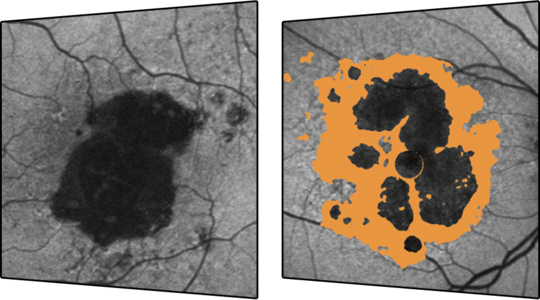
Fundus autofluorescence, or FAF, is the concept of using naturally occurring fluorescence from the retina to provide an indicator of RPE health. Illuminating the retina with blue light at 488 nm causes certain cellular components to “glow” without injecting any dye. This glow (fluorescence) returning from the retina can be used to create a black-and-white image which can be interpreted by recognizing characteristic patterns, in much the same way clinicians learn to recognize the characteristic patterns in a fluorescein angiogram.

Autofluorescence pattern in a healthy eye
Studies have shown that the primary component of autofluorescence is lipofuscin. Lipofuscin appears to be a toxic by-product of photoreceptor shedding which accumulates in the lysosomal compartment of the RPE cell. This by-product is constantly being cleared by the RPE and choriocapillaris, but through the body’s aging process and/or in association with various retinal diseases, clearing begins to slow down, leading to excessive build up. At critical concentrations, the excess lipofuscin interferes with normal cell function leading to cell death.
You need the Flash Player to view this video.
Movie: 3-years progression of geographic atrophy – click to view
Distinct patterns of fundus autofluorescence (or absence of autofluorescence) correlating with RPE death are most strongly seen in age-related macular degeneration, Best’s disease and Stargardt’s disease. Other disruptions of the RPE that can be seen in FAF images include: idiopathic central serous chorioretinopathy, pigment epithelial detachments due to AMD, and polypoidal choroidal vasculopathy.
Holz and others have suggested that high accumulation of lipofuscin at the edge of areas of geographic atrophy may be predictive of future atrophy and that some patterns of FAF are predictive of speed of atrophy.

FAF – Central serous chorioretinopathy